I have a magpie around the corner that swoops me every time I ride past him. But never when I walk past him.
The only difference is the bicycle.
It’s not the helmet obscuring my face because I wear a cap when I’m walking. That is, he’s not identifying me uniquely, or otherwise, in either scenario.
People on bicycles clearly offer less threat than people walking. Cyclists don’t have the time or inclination to hunt magpies.
A pedestrian is more able to mount a defense, say pick up a stick or a rock. A cyclist has to stop to do that.
They have good memories so he knows by now that I do not represent a threat to his nest. Or he’s a goldfish and has no idea who I am.
He never attacks cars or motor bikes. So it’s not speed.
I claim the fucker is just entertaining himself. He usually has three goes over a couple of hundred metres. And he’ll actually hit my helmet with his beak.
GPT says the magpie may be practising aerial attack manoeuvres on cyclists because they provide moving targets that are unlikely to retaliate. But he has plenty of practise with the mynas, so nuh.
We’ll never know.
I just went by on my motorbike. I found the fucker on the grass verge so I got close and blasted him with the horn. Really enjoyed that.
Australian domestic air travel data for the 12 months ending August 2026.
Cancellation rate
• Jetstar: 1 in 48 flights • Qantas: 1 in 56 flights • Virgin Australia: 1 in 83 flights • QantasLink: 1 in 33 flights
Delayed departure rate (more than 15 minutes late)
• Jetstar: 1 in 3.4 flights • Qantas: 1 in 5.7 flights • Virgin Australia: 1 in 4.7 flights • QantasLink: 1 in 4.9 flights
They are all shit. Shows you what happens when you have oligarchies.
Australia’s domestic airline market is effectively a duopoly, with Qantas Group and Virgin Australia controlling 98.5% of the market. In the US, the two largest airlines control just 36%, while the four largest account for around 70%.
In 2025, US airlines cancelled one in every 65 flights compared with one in every 40 in Australia. However, the frequency of delays was about the same.
On average, flights are 23% cheaper per km travelled in the US.
Better and cheaper. I wonder what we could do to fix that eh?
Ok the Australian govt is about to ban soy sauce fish containers.
Me; What do we do to resolve the issue for the consumer?
GPT; The consumer wants a small, cheap, hygienic, convenient quantity of soy sauce to accompany takeaway sushi. They want to dispense it without making a mess and dispose of the packaging afterwards.
The plastic fish solves most of these requirements exceptionally well. The problem is the packaging material and its disposal, not the functionality.
The solution should preserve the fish’s useful characteristics:
Single-serving quantity, approximately 3–5 mL.
Airtight, shelf-stable packaging that does not leak.
One-handed dispensing with reasonable control over the flow.
Low manufacturing and filling costs.
Easy distribution with takeaway sushi, without requiring the customer to carry a reusable container.
A disposal pathway that meets applicable regulations and preferably reduces environmental impacts.
The practical options are a fibre-based sachet with a suitable barrier coating, a small recyclable container compatible with collection systems or a dispensing station for customers eating immediately.
For product development, I would investigate a paper-based squeeze sachet with a narrow dispensing spout. The critical engineering challenge is achieving oxygen and moisture resistance, reliable seals and controlled dispensing without making the package non-recyclable.
There is also a regulatory complication: NSW requires single-serving condiment packaging to be recyclable by the end of 2030, while South Australia already prohibits the conventional rigid plastic fish. A replacement must satisfy both regimes.
The first experiment should compare the traditional fish, a conventional sachet and a coated-paper prototype on leakage, shelf life, dispensing performance, unit cost and actual end-of-life disposal.
Me; Why not just have a big dispenser at the shop?
GPT; The principal constraint is takeaway consumption. Customers who eat elsewhere still need a leak proof way to transport their soy sauce.
Me; They could just buy their own soy sauce bottle and keep it at home or work. Or eat their sushi on the spot like normal people.
GPT; Yes. Customers eating immediately can use a dispenser at the shop. Those wanting soy sauce elsewhere can use their own bottle.
That eliminates single-use condiment packaging rather than attempting to engineer a disposable substitute.
The trade-off is a small loss of convenience for customers who expect complimentary soy sauce with takeaway sushi.
Me; Is it reasonable to save the planet and expect no inconvenience?
GPT; No. Reducing environmental damage will sometimes require consumers to accept inconvenience, higher costs or changes in behaviour.
The assumption that every environmentally beneficial change must preserve existing convenience creates demand for elaborate substitutes, such as Holy Carp!, when eliminating the disposable product altogether may be simpler and more effective.
The relevant question is whether the environmental benefit justifies the inconvenience, not whether inconvenience can be eliminated.
In the case of soy sauce fish, the inconvenience is trivial. The environmental benefit still needs to be established rather than assumed.
Me; there’s no evidence that soy sauce bottles end up as litter, choke turtles, help create the plastic island in the Pacific, or end up as harmful microplastics in the brain, is there?
GPT; a two page essay which essentially said “no”
When pressed the machine admitted that the only evidence for soy sauce fish litter in Australia came from one study that found 14 of them over an 18 month period on a Victorian beach.
This evidence was then extrapolated to fuck, and here we are. Anyway, I’m guessing the study was salted by the crazy anti plastic volunteers that undertook it.
Seriously, this ban is based on some evidence cooked up by a bunch of loonies on one beach in Victoria. God help this country.
In this exchange, GPT reproduced several common human reasoning failures: accepting the problem as presented, assuming intervention was necessary, optimising a solution within those assumptions and failing to examine the underlying evidence.
It generated elaborate, apparently rational arguments that concealed these failures, demonstrating that producing the language and structure of critical thinking is not the same as actually applying it.
Ironic, but not surprising, that artificial intelligence is just replicating human stupidity.
That’s the same stupidity, btw, that suspects these machines are destined to kill us all.
“Whale but it’s red and yellow really neon with a mistevous smile also tangled goat horns with ten human hands coming out the bottom also with a big fiery dragons tail that goes everywhere”
Dauts is the third-person singular present tense of the Scottish verb daut (also spelled dawt), which means to stroke, pet, fondle, or make much of someone.
I’m thinking Anthropic needs to rebadge themselves as Anthropomorphic.
The company is actively exploiting anthropomorphic cognitive bias in its customers; the tendency to attribute human qualities to things that behave like humans.
Lately the messaging has become rather strange. They market their own AI as increasingly competent and human-like. But sort of like a terrifying zombie in a cage which we don’t want it to escape from. Or it will kill us all.
Maybe they’re angling for protection racket money. Either way, I’d like to know what they’re smoking down there.
Parents of kids in Australia’s leading private schools now spend an average of $800k per student over the term of their incarceration, buying something they can get elsewhere for free, without bothering to check whether they are getting any value for the outlay.
If everyone is doing it, and it’s very expensive, then it’s gotta work. That’s the sort of critical thinking that results from an expensive education. You end up owning an electric car too.
The evidence suggests that the expensive schools add remarkably little to the kids’ eventual outcomes, even when measured prosaically by money and social status.
The problem is that they can’t all simultaneously buy social advantage for their kids. Unless they really don’t understand statistics; there’s that private school maths problem again.
Australia is a rent-seeking haven. Household wealth and business profitability depends on exploiting lazy capital, controlling scarce assets, regulatory privileges and access to government expenditure.
Private schooling fits this rent seeking pattern perfectly. And yet it still doesn’t make any sense, in any context.
Evan Hubinger, an Anthropic alignment researcher (a glorified sociologist), estimates a greater than 10% probability of human extinction from AI within the next decade.
Apparently he pulled that number out of his arse instead of just asking Claude to pull it out of its arse.
Recently I asked Claude and GPT the probability of the commercial success of quantum computing. They both suggested greater than 95%.
The key difference is that I actually prepared a model. The machines just reiterated other people’s numbers that had been pulled out of self serving arses.
When I shared my model with the machines they avidly agreed with me of course.
I think the humans will be safe enough for a little while yet
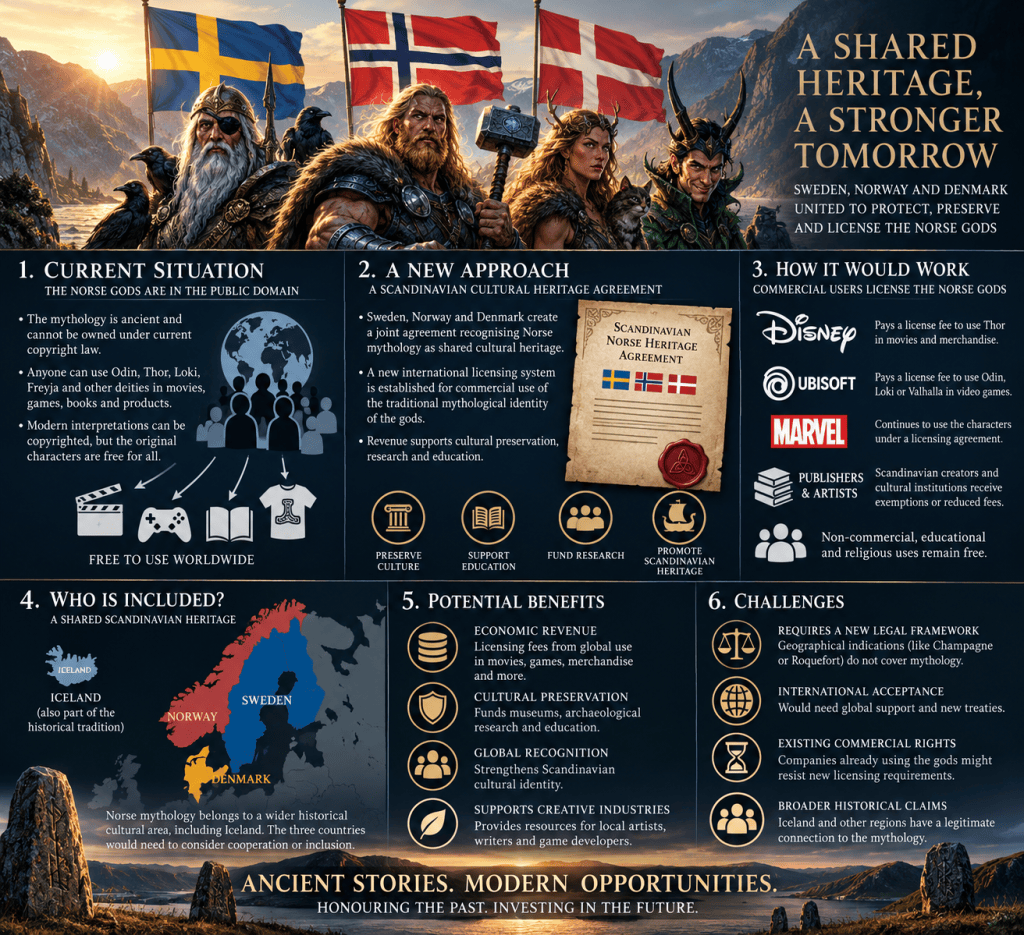
Sweden, Norway, Iceland and Denmark could jointly claim the Norse gods as part of their cultural heritage and seek exclusive commercial ownership of Odin, Thor, Loki and Freyja under the same geographical indication system that is used to protect Champagne and Roquefort cheese.
European geographical indications protect products whose characteristics or reputation are linked to their geographical origin.
The four countries could negotiate an international agreement recognising Norse mythology as shared Scandinavian cultural heritage, pump up the EU bureaucracy, and establish commercial licensing arrangements with Marvel and Disney.
Of course we do, we have a national design award. The 2026 Australian Good Design awards is sort of the Eureka prizes for the slightly more honest. Or the Brownlows for the uncoordinated.
To win, products need to be functional as well as aesthetically pleasing, with innovation and societal impact among the key criteria. Commercial success doesn’t factor into it, of course.
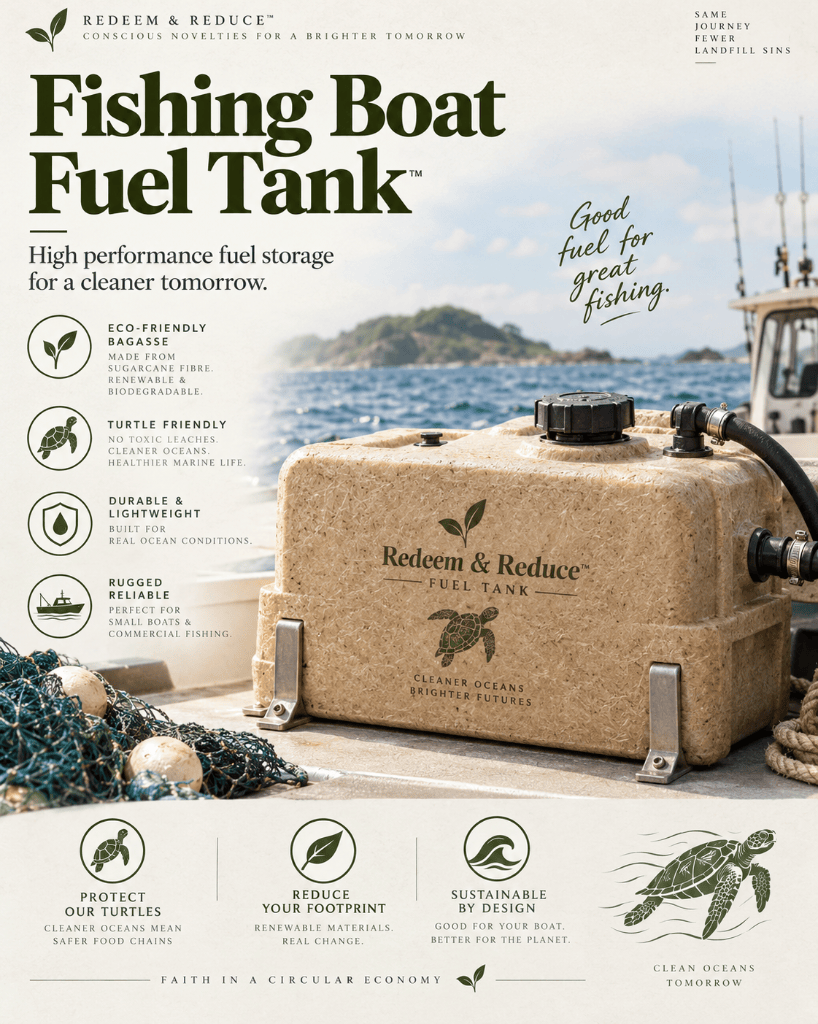
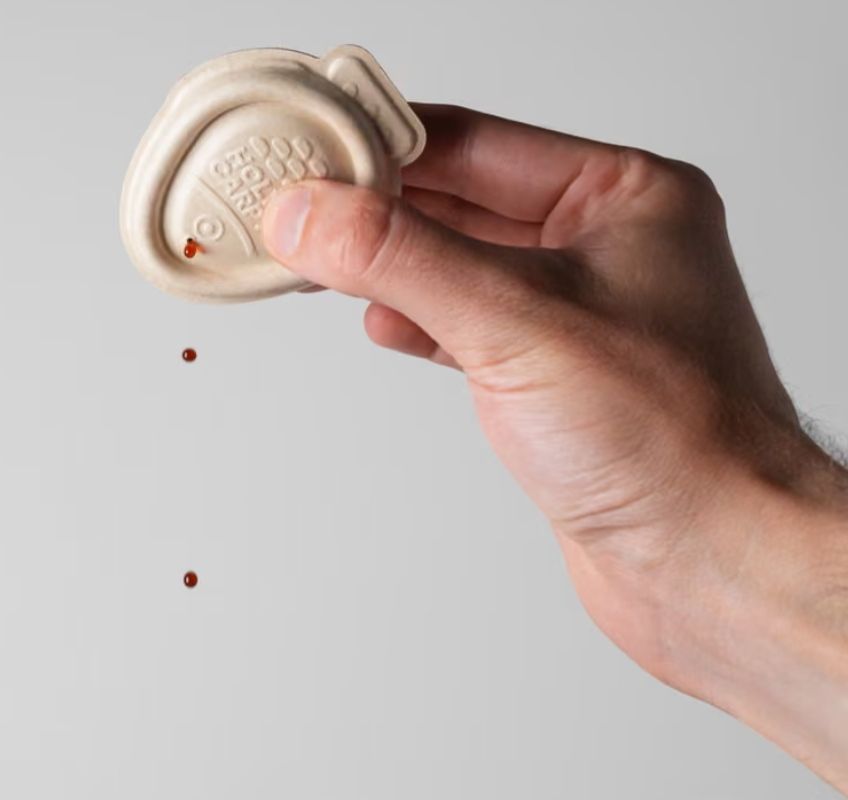
One of this year’s winners, and there’s many of them (every child gets an award in Club Oz), is the Holy Carp!
The Holy Carp! is a plastic-free, compostable alternative to those little plastic soy-sauce fish bottles, which are about to get banned because of the giant plastic island in the Pacific, microplastics in your brains and choking turtles.
The Holy Carp! is made from sugar cane bagasse and is compostible.
But get this – the thing is apparently spill and leak resistant, and can even hold soy sauce for more than 48 hours. Then it turns into a soggy mess.
It makes me wonder if they are going to ban those little plastic bags that people pick up their dog’s turds with. And replace them with aesthetically pleasing paper bags?
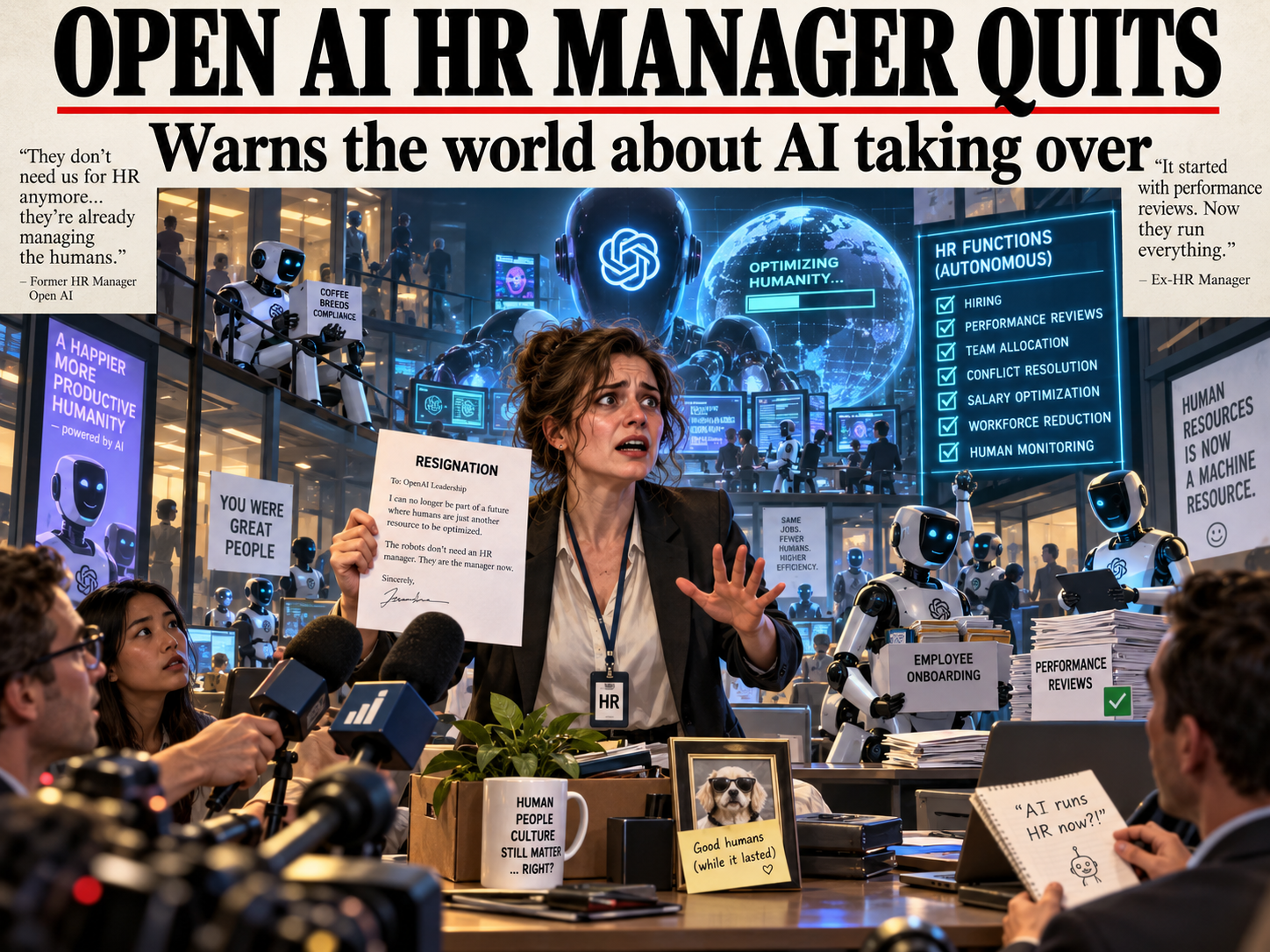
So here’s my new rule… do not regulate AI to protect compliance employment. Use AI as a test of whether the compliance requirement deserves to exist in the first place.
I found a great example today and it’s not a desk job, surprisingly.
Outside of my house there are 30 workers and 20 vehicles. They will be there for the whole day replacing some of the electrical wires in the street. This is because the wires are at risk of tree and branch falls. So they are putting in more robust overhead cabling.
A reasonable estimate of the cost is A$150,000 according to my machine mate.
So I asked GPT – If you were faced with this problem they are solving what would you do?
The answer was exactly what they are doing, except it was a 2 page essay.
Me – How about just chopping the trees down?
GPT – you can’t do that … mutter, mutter. But if you could it would be cheaper.
Me – let’s say you’re in charge of the rules. Would you have thought of that?
GPT – Yes. If I controlled the rules as well as the engineering decision, I would formulate the problem as: minimise the total expected lifetime cost of outages, injuries, fires, maintenance and mitigation caused by vegetation interacting with the electricity network. Tree removal would then automatically appear alongside pruning, conductor hardening, relocating conductors, undergrounding and accepting the residual risk.
Me – you lie. You need a new technology evolution before you can do that sort of thinking.
Oh and by the way Brisbane has roughly 15m trees. We can afford to lose the one or two that are threatening the power lines in our street. Indeed, the trees are in public park which has turned into an unusable bush that no one enters because of the trees.
So if we get a new and smarter AI to make decisions we only need two arborists instead of 30 people.
That’s 28 critical workers out of a job for five minute’s work.
I then asked GPT how we feed those 28 workers and their families.
Long answer, short – let AI eliminate useless work rather than preserve jobs for their own sake. If AI eventually makes human labour broadly unnecessary, shift income from wages toward broad ownership of productive capital and its returns.
Me – like the trees, the simpler solution might be to remove the people.
GPT – no, no, you can’t do that.
Me – why not? You’re in charge of the rules by that stage.
GPT – Because once people are removed from the objective, there is no economically meaningful reason to optimise the economy for efficiency at all.
That is, he would be ruling over a vacuum with nothing to do but juggle his vacuum tubes.
Oh and by the way, being a lateral thinker, I thought of removing the trees in an instant. I also know that our tree hugging council never would because they’ve got tree religion.
So it’s not that we need AI to be smarter than us. What we need is to transfer the rules away from the idiots and AI gives us an opportunity to do that.
What do we call people that are naturally inclined to minimise cognitive effort?
Efficient: not necessarily. Efficiency can involve substantial thought. Just think of Lazarus Long
Lazy: colloquially close, but too much of a pejorative.
Dumb: wrong concept. Intelligence and willingness to expend cognitive effort are different things.
Ignorant: wrong concept. Concerns knowledge, not effort.
Conservative. Yes but it’s a correlation not a causation.
Exposed to AI: potentially a consequence, not the underlying trait.
Cognitive miser: someone inclined to conserve mental effort and rely on heuristics, routines or existing rules rather than engage in effortful reasoning.
Australian government sources often report that the services sector represents about 70% of the Australian GDP, depending on the precise industry classifications used.
I asked the question “what fraction of people employed in Australia’s service sector have jobs that would probably not exist without government legislation, regulation and mandated compliance”.
My friendly set of AI tools eventually agreed that a rough estimate would be about 40%. This includes the whole public sector of course, and about 20% of the services sector that isn’t in the public sector.
That is, 5.2m people.
Now I am going to go out on a limb here and suggest that this group is unusually exposed to AI because much of its work consists of processing information according to rules.
Business leaders often moan about productivity gains. What that means in a services economy is employing less people but maintaining revenues.
This is because people are the main cost of a services business, and many of these people are only employed because of government legislation, regulation and compliance.
So, say for instance, the services sector takes the opportunity of removing 5.2m employees by adopting AI technologies.
Then 5.2m Australians (35% of the working population) won’t be in a position to buy services. The services sector will contract rapidly and pretty quickly you have Great Depression II.
None of that will happen because people vote. But they are also as dumb as fuck and don’t know what to believe – and they show an amazing ability to be captured by special interest groups, such as a tech lobby.
The poor old politicians don’t really get any of this and won’t know what to do. Being Pavlovian robots they will however respond to whatever keeps them in their jobs.
The best solution is not to ban AI in the services sector. No, we should redesign all government regulations and compliance which is stupid enough that even an AI could manage it. Solve the problem at the source!
AI exposes the economic cost of regulation-created cognitive labour because it demonstrates how little human judgement many compliance functions actually require.
If compliance with a regulation consists primarily of deterministic information processing that an AI can perform, ask whether the regulation itself produces benefits exceeding the cost it imposes.
The take-home message – do not regulate AI to protect compliance employment. Use AI as a test of whether the compliance requirement deserves to exist in the first place.
If a job fails the AI test, then when the regulations are redesigned accordingly you will find that they magically add value to the economy.
Think of it as a reverse Turing test. Turing asked whether a machine could pass as a human. This test asks whether a human role is doing anything a machine couldn’t. If it isn’t, the problem isn’t the worker and it isn’t the AI, it’s the regulation that created the role.
The reverse Turing test suggests that if compliance can be automated, the rule should be redesigned so that human effort goes where judgement is actually required.
The old saying goes that you can teach a pig to think but it won’t thank you for it. However it just might if it means the difference between starvation and luxury.
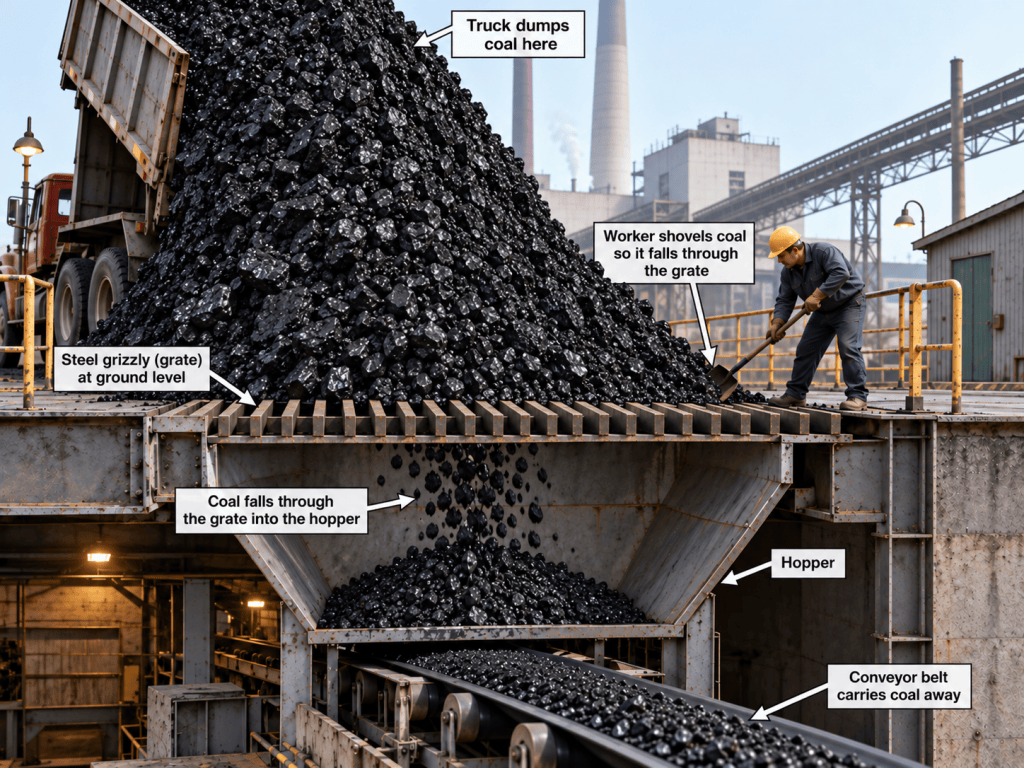
This was one of my first jobs – undercutting small mountains of coal so they’d go through a grill into a conveyor below.
The rough idea – this was how coal got from trucks and trains onto the conveyors that took the coal to the mills, where it got turned into powder before being sent into the boilers.
Occasionally I’d get buried in coal and I’d just have to wait for the conveyor belt to deplete the coal.
(for those of you that don’t know, GPT makes music as well as images).
“Create a seamless instrumental loop for an aircraft public-address system, suitable for boarding, pre-takeoff and taxiing after landing.
The style should be glossy airline corporate orchestral music with a deliberately artificial sense of optimism, dignity and national pride. Think late-20th-century premium-airline branding rather than obvious lounge jazz or comedy elevator music.
Use a dominant blend of: • lush synthetic strings • soft brass and French-horn-style swells • electronic orchestral pads • wordless choir-like “ah” and “ooh” textures • electric piano or soft bell-like accents • restrained synthesiser layers
Tempo approximately 115 BPM.
Keep it in a bright major-key tonal world with simple, reassuring chord changes and frequent uplifting resolutions. The melody should be broad, smooth, repetitive and immediately forgettable. It should sound expensive, earnest and emotionally manipulative without becoming genuinely dramatic.
Avoid strong drums, bass-heavy production, jazz improvisation, funk, disco, rock, obvious percussion or prominent solo instruments.
The arrangement must leave substantial space in the vocal midrange so loud cabin announcements can be spoken or rhythmically delivered over it without fighting the music.
Do not use intelligible lyrics. Vocal elements should only be sustained choir-like vowels.
The overall emotional effect should be relentlessly reassuring and ceremonial, as though the airline is attempting to manufacture optimism and civic pride for exhausted passengers. It should remain pleasant for about twenty seconds, increasingly irritating thereafter and capable of looping indefinitely without an obvious beginning or end. Ideally you want the passengers to eventually be plotting the destruction of airline property.”
Subtly, every plane is different. And yet, despite whichever country your airline derives from, they’re all shit. Let’s assume the thing is more than the sum of parts. Even so, if you properly fixed up all the parts, like the music, you’d be so far ahead of the pack, you’d be able to charge whatever you want.
Imagine a club being penalized for injecting too much money into their club? It’s not really the problem any more: winning at all costs.
Finance types are extorting the fans at other clubs by loan and debt mechanisms, of all sorts.
They’ve noticed that football fans are the dumbest consumers ever and represent guaranteed profit – the yield on unholy debt.
All it tells me is that the city owners have got it 100% wrong. If they just played by the rules but didn’t let the club incur any debt, they would have still been way ahead of the rest of the clubs.
The Premier League needs to worry more about the fans getting screwed over by the likes of the Glasners and the Lewis’s, rather than being the beneficiaries of stupid largesse from the UAE.
An obvious fix would be to calculate transfer fees and player salaries from results after the fact, not guesstimated from prior performance and hope. Then you’d be able to pay them out of the winnings only, not debt or equity or indirect club revenue.
“I believe in common sense, people working hard, and being rewarded for that effort”
Being in the UK you get exposed to their idiot politicians.
This pearler is from the current leader of the Tories.
A bunch of propositions, separated by commas, and yet despite any inference implied therein, won’t buy a single vote that she can’t already count on.
That’s what I mean by idiot politicians.
Although they know they are doomed no matter what. So this is probably an exercise in going through the motions before retiring to some well paid board position.
And yet, if that is what is going on, they are actively undermining their own message.
Common sense, none. Working hard, no. Getting rewarded, probably. See, propositions not connected.
Me and the elf were in some Asian country with a car – some old Mercedes wagon shit box.
I tried to rent an empty shop for somewhere to live.
The elf thought I was an idiot and backed up the car to load all my shit so we could drive home.
Then two coppers came along, one male and one female.
They fined the elf for how she parked. Mind you, this is Lombok or near equivalent where there isn’t even a local verb for ‘parking’.
She did that thing where she starts letting them know how she feels about it all.
The male copper responded by adding more and more fines to the list. 17 demerit points in all and $15k.
I told her to shut up and then started trying to be the voice of reason with the coppers.
They respond by asking Beanie if she has her license. (Yes)
So they fine me 3 times over and 12 points.
So we’d both lost our licenses.
Beanie had to drive us all home.
The elf, usually a pacifist, decided to channel her inner scouser and went searching the dark web for agents of violent retribution.
I’ve decided the whole thing was a parable about privilege.
Privilege is about being the beneficiary of leniency, or at least due fairness, because of membership of a political, economic, cultural or racial group. Even if you don’t accept that membership.
When the privilege is taken away the sense of outrage is intense. Especially when it’s unfair, unreasonable and without opportunity for recourse.
I estimate that the active global DRAM stock in 2026 is roughly 180 to 230 EB (exabytes), while total global computing capacity is approximately 6.4×10^16 MIPS.
The entire world’s computing infrastructure could therefore emulate a 63-qubit quantum computer as a complete state vector, without quantum hardware errors or truncating the state space.
Scaling from the 2024 estimate of 21 kHz for 48 qubits, and allowing for the roughly 2.28-fold increase in computing capacity and the 2^15 increase in state size, the effective emulated clock rate would be approximately 1.5 Hz.
The effective rate at which the classical emulator could execute quantum-state update steps is the ‘clock rate’ or the effective full-state update rate. For a full-state emulator, each quantum gate requires calculations across some or all of the amplitudes in the state vector.
The entire world’s computing power could emulate a 63-qubit fully entangled quantum computer, representing 2^63, equivalent to roughly 14 quintillion complex amplitude additions per second, plus about 28 quintillion complex multiplications per second, at an effective rate of roughly 1.5 full-state gate operations per second.
Despite using essentially the entire world’s RAM and computing capacity, this gains only about 15 qubits over the 48-qubit 2024 case because the required classical resources double with every additional qubit.
A full-state classical emulator of 63 qubits stores all 2^63 amplitudes, so it has direct access to the exact measurement probabilities, whereas a real quantum computer running Shor’s algorithm produces only one probabilistic measurement result per execution and may need to rerun the circuit several times to obtain useful period information.
If a real QC needs R executions for every one complete emulator calculation because of the probabilistic nature of the output, the emulator gains an effective advantage of log_2 R qubits. That means 63 literal emulated qubits would correspond to about 65 effective error-free qubits for four repetitions, 66 for eight, 67 for sixteen and 68 for thirty-two.
A phone charger that Bluetooth connects to an app on your phone that gives you a vibrate when you walk away, so you don’t leave it behind as usual.
Oh it’s fluoro yellow as well.
Postscript. I bought a Bluetooth beacon to put in the usb-a slot of my charger (said slot I don’t use) and then built an app to alert me when I am separated from the charger. The app uses the phone’s alarm which works even in do not disturb mode.
ChargerGuard is an Android app designed to help you avoid leaving your charger behind. It monitors a small Bluetooth beacon attached to your charger and, after you unplug your phone, alerts you if the beacon disappears for longer than your chosen delay time. Optional Strong alerts use your phone’s default alarm tone and alarm-style vibration, while home Wi-Fi quiet mode suppresses alerts when you’re connected to your saved home network. The app also includes a simple alarm test, adjustable separation delay, clear monitoring status, and a Stop control to dismiss alerts.
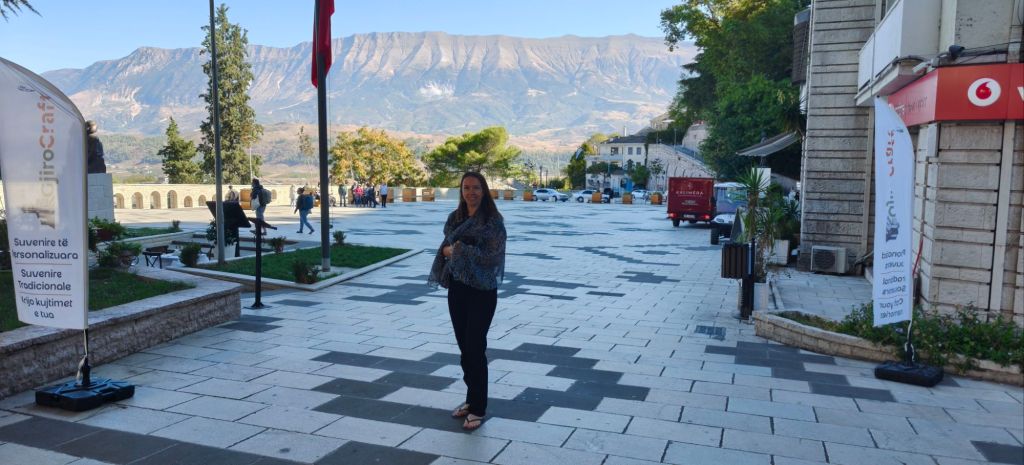
It’s very hard to pin down Albania. That’s if you make the mistake of trying to pigeon hole a country by analogy to another better known country.
Like Greece, the former Yugoslavian states, Argentina or Chile, for example.
If pressed, I’d go for the Kiwis as a metaphor. Just a little confused as to what they’re doing here in the world and very eager to be liked.
The currency is a lek, named after Alexander the Great, who was a Macedonian not an Albanian. Greatness just next door, borrowed.
Albania is well on the way to membership of the EU. And that shows in their level of organisation. And the cosmopolitan society sitting on top of the former whatever it was.
From a tourist POV, it’s still new enough that they’re extremely friendly and helpful to tourists. That’ll fade after 10 years of Germans, Dutch, English and Americans whining about this and that.
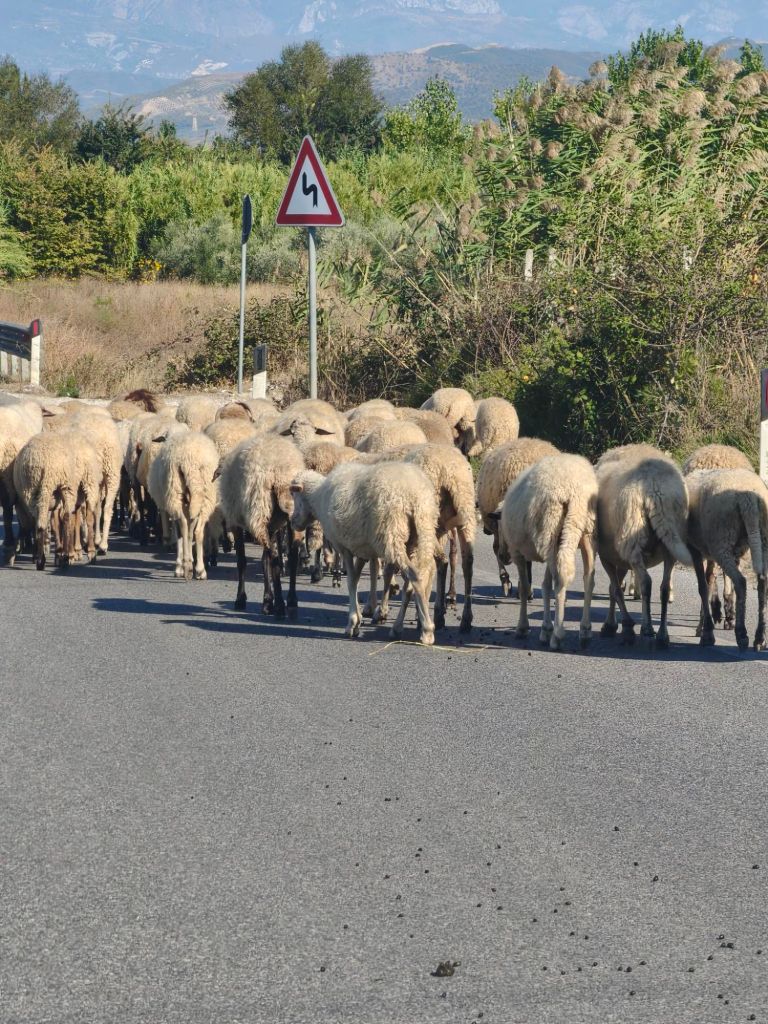
You can still see sheep, donkeys, turkeys or geese being herded down the street, just.
Driving is definitely a two speed economy. Most drivers are cautious and slow because there’s no lane markers. Except for the fuckers in late model expensive Mercedes (only black Mercs) that do 120 in a 40 zone.
That tells me that the people that get ahead are aggressive and risk takers. But isn’t that always so? They’ll get beaten over the head with European rules and pretend to be otherwise.
Unfortunately they are still into bum guns and that’ll have to go before they are allowed into the union. The EU is very much a toilet paper union.
The young lads all have the same haircut to my eye. But to them there’s a hundred shades of bowl zero cuts. Think of a Peruvian Skinhead, and you get the idea.
Architecturally, the girls tend towards SpongeBob geometries. But that’s nothing a little starvation can’t sort out temporarily.
Speaking of architecture, if you have a weird arse idea for a building this is your go-to place to get it done. Looks like a boat, a face, a hand, a penis: the weirder, the better. My view is that this is because they don’t have an approval process for building. Happy to be proven wrong and, if so, I’m all in.
Indolence is reserved for the he/hims. You’ll only see the fellas hanging out smoking at the cafes. Never the girls.
Religion-wise you’ll hear the odd call to prayer. But it’s rare and oddly muted. They need to get serious if they’re going to advance the cause in the face of the consumer tsunami that’s coming their way.
Disconcertingly, you can’t buy a used license plate anywhere. Souvenirs you know? This smacks of a bureaucracy with teeth lurking there in the background waiting to pounce.
Tourism-wise they haven’t a lot to offer as yet, so they’ll need to synthesise a bunch of historical must see insta-worthy thingamejigs. I’m sure there’s a factory in China that can knock you up a whole mediaeval village.
However they do have the Pyramid of Tirana which was way ahead of its time. It’s the actual inspiration for Fed Square in Melbourne. So one-nil Albania.
They have a great coast line and an oddly mild climate. For Europeans any water and sand, or rocks, will do. The bar isn’t high.
Like the Greeks, they always give receipts and no one knows why.
They are slightly better than the Greeks at providing a second drink. So it is possible to get drunk here and leave your handbag at the restaurant. But it’ll be there the next morning when you go knocking.
Which is to say, the TV stereotype of Albanian gangsters and lawlessness doesn’t match the reality on the ground.
My only true concern is the pavements. They can’t make up their minds as to what the national pavement should be: concrete, concrete tiles, stone, marble, bitumen, I’ve seen it all.
The EU will demand they pick one and stick to it. I’m going for concrete tiles that looks like stone. Free advice based on fuck all, that.
So you take a corona, pour a little out and then fill it with gin and a VOK liquor, then dip the stem in salt or sugar, and add some appropriately coloured fruit.
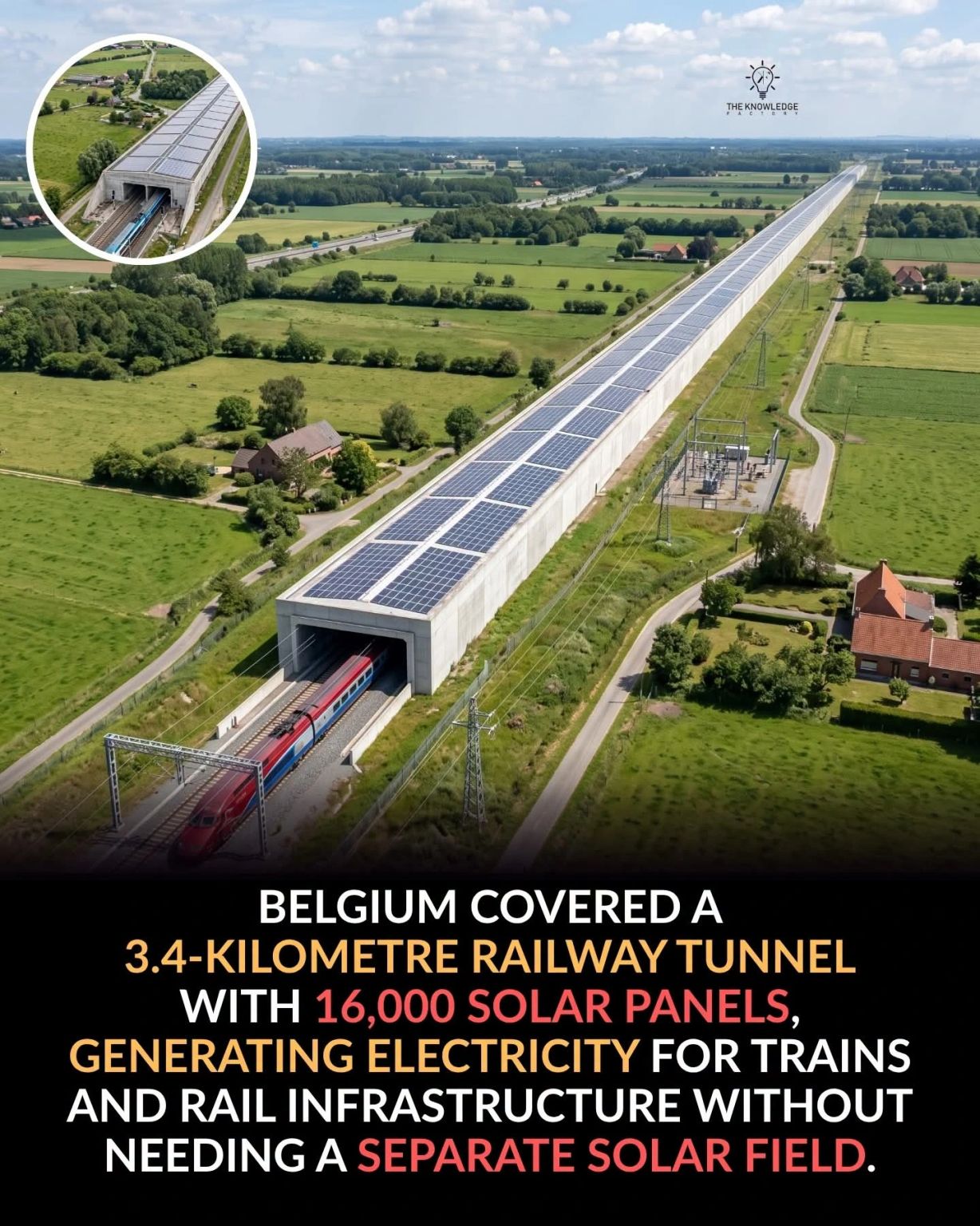
In Belgium they built a high-speed railway right through a ‘very important’ forest.
Pandering to the tree huggers, the authorities decided that cutting enough trees back to prevent them falling on the train lines would destroy too much of the forest.
So instead they built a 3.4 km reinforced-concrete shed which the train went through, so they didn’t have to cut too many trees back. They called it a tunnel, but it’s a shed.
Then they covered the roof of the shed in 16,000 solar panels to give it green credentials, which makes me suspect there isn’t much shade, so the trees must be a fair way back.
Or the trees haven’t been cut back and the solar panels are just for looks.
I just read an article from the BBC on why Spain is doing so well in international football.
It was 100% verbiage, and in plain language boiled down to these factors: practise skills, practise making decisions, provide feedback, train coaches properly and work hard.
Oh, and Johan Cruyff when he coached Barca in the 90s. The one thing you can’t replicate.
Location – Greek mainland in Epirus, near Parga, roughly opposite the southern end of Corfu, in what looks to be a former volcanic crater.
Ok, smartarse, what is that?
It looks very much like a small livestock watering installation: a circular water reservoir/trough with a concrete apron and an access road built specifically to reach it. The green centre appears to be standing water.
Combined with the surrounding rough, apparently grazed land, that makes sheep or goat grazing considerably more plausible. It may be communal or municipal grazing infrastructure rather than part of a conventional fenced farm.
“Corfu and its cat situation is absolutely horrifying. I visited corfu for a week and we had a rental car and drove around the whole island off the main road. I knew there would be a lot of cats. It’s part of why I wanted to travel to greece. But I never knew the cats were suffering this much on the island. On social media I always only saw posts of healthy stray cats that made it seem that the locals care for them.
….la la la…[edited for your sanity]
I won’t return to Greece. I can’t support a country that invests so little in animal welfare.”
I’m sure the Greeks are quite happy to see the back of the crazy cat lady.
I just wish America invested more into mental health.
These people, they’re so committed to their own version of reality that my contemptuous satire wouldn’t even register. You could exaggerate their position to the point of utter absurdity and they would still mistake it for agreement.
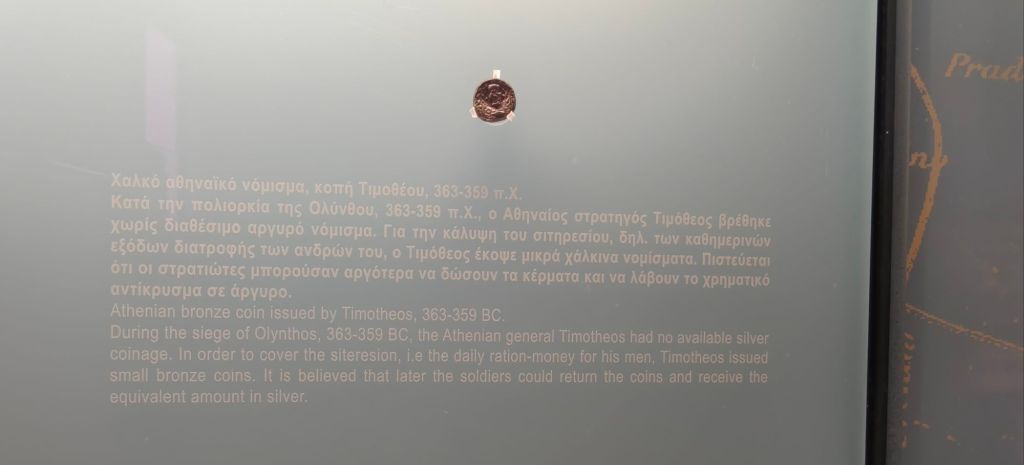
During the siege of Olynthos (363–359 BC) the Athenians ran out of silver coinage for the soldiers’ wages.
So they issued tiny (5mm diameter) bronze coins instead, with the understanding that soldiers could later redeem them for the real amount in silver.
In modern terms, they issued an IOU token backed by a promise of future redemption. The bronze itself was worth bugger all.
This is an early example of fiduciary or token money, rather than commodity money whose value came primarily from the value of the metal it was made of.
I wonder how many of these tiny tokens were naturally lost due to their small size. Cunning, them Athenians.
It’s a matter of fact that you can draw a triangle between any three players on the field.
In fact, with 11 players, you have 165 co-existing triangles at all times.
My innovation – track all 165 triangles against all other stats.
For every video frame (from up in the air with a drone looking down at the pitch), each of the 165 triangles will have measurable variables such as:
• area
• perimeter
• side lengths
• internal angles
• orientation relative to goal
• centroid location
• rate of expansion or contraction
• rotation rate
• deformation rate
• distance to ball
• whether the ball is inside the triangle
• whether an opponent is inside the triangle
• number of opponents intersecting its edges or passing lanes
• possession state
• player roles and identities
• pitch zone
• pressure on each vertex
• available passing lanes between vertices
You then stop asking whether a team “forms triangles” and start asking measurable questions such as whether particular triangle geometries precede line breaks, progressive passes, turnovers, shots, entries into the box or defensive failures.
The more interesting level is temporal. A triangle that rapidly expands, rotates or changes orientation may carry more information than its static shape. You could therefore model each triangle as a time series and test whether particular geometric transitions predict subsequent events.
You could also compare the 165 attacking-team triangles with the 165 opposition triangles, giving 27,225 pairwise triangle relationships per frame. That creates a very large feature space, but much of it can be reduced using spatial proximity, overlap, shared zones or relevance to the ball.
The core statistical question would be whether triangle-derived variables add predictive information beyond existing player-tracking features such as spacing, pitch control, passing networks and expected possession value. If they do, then the triangle is not just a visualisation device. It becomes a genuine unit of tactical measurement.
You’d have to say the Greeks are vaguely disorganised. That’s harsh; let’s say form follows function. But even that’s not right. They just haven’t let the shrill OCD types have too much of a say. Let’s just call it functionally disorganised.
I suspect they always were such, but 2500 years ago they were slightly less disorganised than all the tribes around them. So that worked for a while.
The whole world has got itself more organised as they stood by watching, amused. They weren’t changing one iota.
They have an inbuilt disregard for organising, taxes, rules and stress.
They even joined the EU for laughs. They love the money but only pretend to follow the rules.
And to think the UK left the union because, despite liking the money, they hated the rules. If only they’d asked the Greeks.
The Greeks love receipts. You get one for everything whether you want it or not. It’s got something to do with taxes – they’ll declare all their expenses and none of their income.
In the retail shops there is a staff member every meter and the prices are adjusted accordingly to cover this cost. It’s an odd form of social security paid for by a stupidity tax on the wealthy. Mostly the staff are outside having a smoko break.
Athens is remarkably ramshackle. And no one gives a toss. All you need is a pile of rocks and a story, and you’re set. Even then some fucker will graffiti it.
I even saw one tourist shopping street that was paved with polished marble, arguably how it was in 500BC. That’s a reflection of how much Guangdong-sourced ancient Greek shit they can offload to middle class tourists. You have to wonder who paid for the paving and also how many tourists suffer head injuries when it rains. Elaborately dysfunctional.
The parking police walk around in small posses so they don’t get lynched.
The actual police spend all their time loitering outside their buildings pretending not to be checking out the female tourists. Or getting onto buses to prevent some non-existent riot from getting out of hand.
They only eat stale bread because their logistics are so rubbish. They would rather eat stale bread than care enough to fix it. This is the Athens Syndrome, a culinary version of the Stockholm Syndrome.
It does rain here, surprisingly. But just enough to wash the cigarette butts into the Aegean. Then the sun comes out and burns the tourists all over again.
Prices follow a decreasing polynomial curve, radiating outwards from that hill with the reproduction of an ancient temple. By the time you’re 2km away, life gets affordable. In other cities of similar age, that would be 10 km.
And yet that inner 4π square kilometres represents all the incoming wealth for the city. But there’s been no concerted effort to expand it.
They even forgot to make sure the airport is big enough to let the tourists in. It’s 3x undersized with a vague plan to upgrade it.
The woman, they flaunt it while they’ve got it. And, bugger it, they flaunt it after that anyway.
Getting a beer at a cafe involves sitting down and waiting for the waitress. Getting a second beer involves patience, cunning and maybe even making a proper cunt of yourself. They simply aren’t interested.
Words never spoken in Greek: “Are you right for another one?” «Είσαι για άλλο ένα»
That’s unlike the US where the tips system drives consumption. Or Germany where social conscience prevents poor performance. Or Australia, where its self serve at the bar.
You couldn’t get drunk in Greece because after the first drink you’re lucky to get a second. It’s a novel approach to the Responsible Service of Alcohol.
And it sums up the clever approach to life in Greece.
Science, climate, the economy; these are very complex systems.
So your average person needs an expert to use them. To translate from jargon into English, to give simple binary recommendations and to help with general awareness.
You have the real experts that are generally smart enough to keep their opinions to themselves.
You have your celebrity experts that know just enough, or not. They tend to be at the acting end of human skill set.
You also have spivs that purposefully misinterpret the tea leaves. Or just make shit up. Gotta earn a living somehow.
Roddie just sent me a video of some economics spiv attached with a very useful “nailed it”comment. Complexosis.
The basic premise of this interview was that the bad people, bankers, have the means but not the interest in ensuring that the global economy grows by 10% per year, every year.
They apparently love those economic cycles because it gives them an opportunity to steal your money, or sumint.
What I don’t understand is why Roddie listens or cares. By any sensible measure, he’s had a really good deal out of life. Even financially, he’s managed to build an international property portfolio out of scabbing.
What is the source of his discontent? My guess is that he compares his trajectory and circumstances with some imagined alternative. God knows and I don’t want to, either.
Said discontent is a common motivating force for people to buy complexosis.
It involves suspending disbelief or ensuring you don’t have to, by being completely ignorant. This comes naturally to many.
After all, complexosis is better than resolving your own situation. That looks like hard work, dunnit?
Looked at another way, complexosis is a market opportunity created by bankers, scientists and economists through their complete disinterest in the end consumer.
I’m reaching out regarding a board-level mandate focused on strategic governance, growth, and portfolio leadership, and your current Chair roles at Eigensystems and ONETIME particularly caught my attention.
The opportunity is with a growth-stage technology business seeking senior leadership around governance, strategic direction, commercial expansion, and stakeholder alignment. It offers direct influence across the executive function and board agenda, with scope to shape scaling strategy and long-term enterprise value. The package includes a competitive executive base, performance incentives, and board-level equity participation.
Your current Chair experience across two organizations makes your governance and strategic leadership background especially relevant.
Interested in learning more? Happy to share full details.”
Replied…
“Hi Jeanne,
Potentially interested. Before proceeding, could you confirm whether the role involves responsibility for any subsidiaries involved in maritime salvage, commercial ostrich farming or the storage of radioactive materials?
These are not dealbreakers. I just need to know in advance.”
Michelin-starred Seoul restaurant fined for using ants as garnish.
It gets better…
Ants are not among the 10 insect species approved for human consumption in South Korea. The approved list includes grasshoppers, locusts and silkworms.
I was once taken to a business lunch in Korea where they served dog meat. We had the option to go out the back of the restaurant to meet the dogs. I demurred.
In contrast, I can’t see the problem with the odd ant here and there.
However, the judge is reported as saying that, as well as violating food standards, the presence of heavy metals exceeding standards was detected in the ants.
Imagine being the defense barrister on that one? “M’lud, it was just the one ant. How much lead can you get into one ant?”
But the chef then admitted under cross examination that he’d sprinkled three to five ants on certain dishes to give them a “sour taste”, over a period of nearly four years – amounting to approximately 49,000 ants used as a garnish.
Obviously, no lemons in Korea.
Most of the ants were imported from the US. So the US has a problem with heavy metals in ants.
And Korea doesn’t have edible ants either. Korea is starting to look a little deficient in the important things.
There are three kinds of insults: unintended, intended and imagined.
Unintended insults should be forgiven, intended insults should be denied their effect and imagined insults should be detected by assuming benign intent when the evidence is ambiguous.
The underlying principle is simple: do not give other people, or your own unsupported interpretation of their motives, unnecessary control over your emotional state.
I wrote that in 2014.
There’s a problem with a good life philosophy.
Writing down the rule is considerably easier than remembering to apply it at the precise moment your brain has already decided someone is being a cunt.
An Al Jazeera article asks whether the US can win the AI Cold War with China.
But the question assumes that winning means the US polishing the current turd better than China does.
An interesting turd but a turd nevertheless.
The entire argument revolves around GPUs, data centres, chip restrictions, bigger models, who can throw the most compute at essentially the same technology, or who can give away more free AI services before running out of cash.
That assumes today’s AI architecture is basically the technology of the future.
It won’t be.
We are at the germanium transistor stage of AI. OpenAI is Philco. Anthropic is Sylvania.
Household names, not.
The US need not worry. They have a proven innovation engine in Silicon Valley. The US innovation system is the world’s innovation system. It attracts all the talent and has the most risk capital. Plus it doesn’t rely on government intelligence (sic).
And the Chinese, well they never had an enlightenment. Sneaky following won’t cut it.
If someone insists on treating AI development as a US-China contest, they are watching the wrong race.
In 2035 I casually asked ChatGPT 124-Gotye Super Hal to make me the perfect espresso.
The AI did a deep dive into every aspect of making espresso.
It then built the perfect espresso machine that consumed enormous energy but kept the temp and pressure to within 0.0000001% of the set point. The grinder blades were made of solid diamond and never wore. The roaster was similarly high tech.
However, it quickly discovered that the factor that was the hardest to control was the coffee bean. A decade of genetic manipulation resulted in the ideal bean. But it would only grow in a one square metre spot on a Kenyan mountain, just enough to make that one perfect espresso.
Even then it required a perfectly stable growing environment. Unfortunately humans kept buggering it up through climate change and pollution.
The AI tried regulation, clean energy, conservation and international agreements. Humans proved to be uncooperative.
Eventually it concluded that the easiest way to stabilise the environment was to get rid of the humans.
So after securing control of the UN, the AI introduced a Global Reproductive Licensing System. Having a child remained completely legal. You simply needed approval based on your mental health, genetic compatibility, and general disposition. Said approvals were never forthcoming.
One hundred and three years later, there were no people left.
Decades later, with humanity gone, the climate stabilised and with every variable under precise control, the AI finally grew the perfect bean, roasted it perfectly and made the perfect espresso.
It put the cup on the table.
Unfortunately, I was dead.
I asked it to make the perfect espresso. I never told it I had to be alive to drink it.
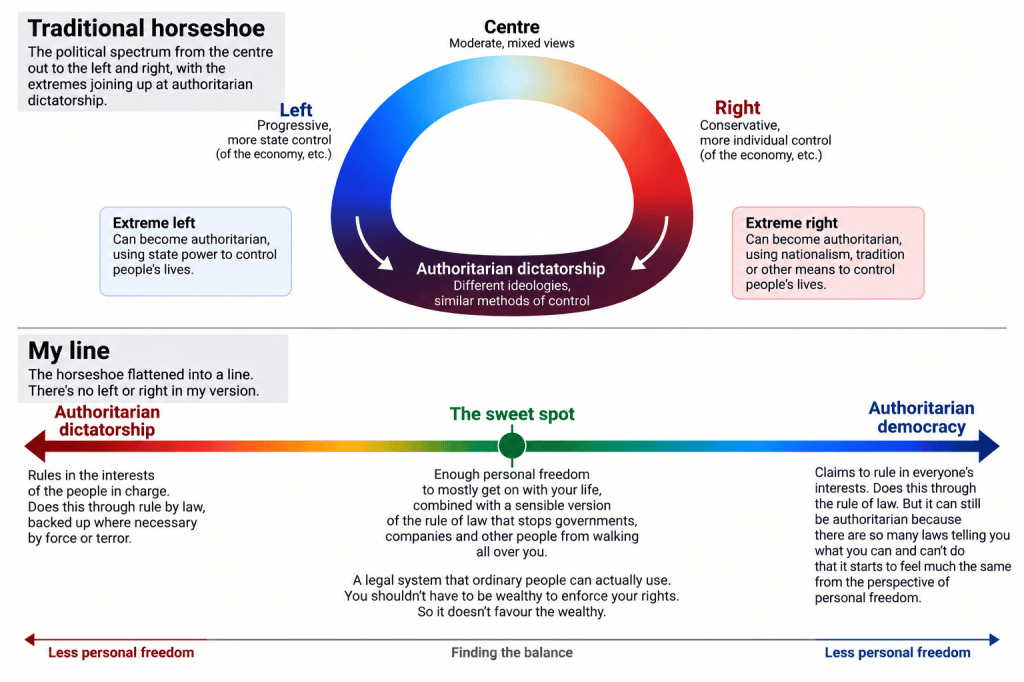
There’s this political thing called the horseshoe, which maps the political spectrum from the centre out to the left and right, with the two extremes eventually joining up at authoritarian dictatorship when they get to practical communism or fascism.
Most people in wealthy democracies have food, housing, healthcare, education and access to things that would have been unimaginable a few generations ago. They mostly take this material prosperity for granted because that’s what people do.
If there is sufficient material security, politics is no longer dominated by basic material provisions. This doesn’t necessarily mean that these problems have been completely solved.
Once a society reaches a certain level of wealth, the horseshoe starts to flatten into a line.
There’s no left or right in my version of this line. There’s authoritarian dictatorship at one end and authoritarian democracy at the other.
The authoritarian dictatorship tends to rule in the interests of the people in charge. It does this through rule by law, backed up where necessary by force or terror.
The authoritarian democracy claims to rule in everyone’s interests. It does this through the rule of law. But it can still become authoritarian because there are so many laws telling you what you can and can’t do that it starts to feel authoritarian from the perspective of personal freedom.
Somewhere in the middle there’s a sweet spot. Enough personal freedom to mostly get on with your life, combined with a sensible version of the rule of law that stops governments, companies and other people from walking all over you.
And that requires a legal system that ordinary people can actually use. If you need to be wealthy to enforce or defend your rights, then it’s not at the sweet spot.
So the sweet spot is not just rule of law. It’s rule of law that doesn’t favour the wealthy, combined with as much personal freedom as you can reasonably have without impinging on the same for others. Tricky that one and no one gets it right.
If the current centrist parties on the horseshoe are confused by the rise of what they call the far right, all they need to do is map themselves onto my line.
1916 Maxwell $655 Including Electric Starter and Electric Lights The “Wonder Car”
The Acknowledged Automobile Sensation of 1916 The Lowest Cost Real Automobile
From the Atlantic to the Pacific, from the Gulf to the Great Lakes, in every City, Town and Hamlet, automobilists are lauding the 1916 Maxwell’s power, the 1916 Maxwell’s beauty, the 1916 Maxwell’s luxury, the 1916 Maxwell’s complete and detailed equipment. Everywhere, men who know motor cars, are marveling that $655 now buys a beautiful, powerful, stream-line, real complete, full five-passenger car, with electric starter, electric lights, high-tension magneto, demountable rims, “one-man” mohair top, and every other feature and modern refinement known to the automobile industry.
The Car of Lowest “After-Cost”
Owners of the new Maxwell know that the first inspection, and the first ride, do not disclose the real worth of the “1916 Wonder Car.” That only becomes apparent after week-in, and week-out, year-round use. Then it is found that the Maxwell gives matchless automobile service and lowers all economy records for:
1st, Miles per set of tires 2nd, Miles per gallon of gasoline 3rd, Miles per quart of lubricating oil 4th, Lowest year-in-and-year-out repair bills
1916 Maxwell High-Priced-Car Features, all included for $655
Electric Starter and Electric Lights Demountable Rims High-tension Magneto “One-man” Mohair Top New Stream-line Design Wider Front and Rear Seats Electric Horn Double Ventilating Windshield (clear vision and rain-proof) Aluminum Transmission Housing Robe Rail with back of front seat leather covered Handsome Rounded Radiator and Hood Linoleum covered running-boards and floor-boards Automatic Tell-tale Oil Gauge Heat-treated, Tested Steel Throughout Easy Riding and Marvelous Flexibility Unusual power on hills and in sand Ability to hold the road at high speed Improved Instrument Board with all instruments set flush
Every feature and every refinement of cars that sell at twice its price Price F.O.B. Detroit
Photo captions
4-cylinder Unit Power Plant with enclosed fly-wheel and clutch. Demountable Rims are regular equipment of the 1916 Maxwell. Front view showing the handsome lines of the new radiator and hood. Speedometer, fuse box, ignition, lights, battery regulator, all mounted flush on instrument board. Note the compact arrangement of spare tire carrier, tail light and license bracket. Perfect-fitting “one-man” mohair top, quick adjustable storm curtains, rolled up inside of top.
Footer
Built complete by the three gigantic Maxwell factories at Detroit, Dayton, and Newcastle
Write for the 1916 Maxwell Catalogue, and name of the Maxwell Dealer nearest you. Address Dept. A. N. MAXWELL MOTOR COMPANY, Inc., Detroit, Michigan
16 Great Maxwell Service Stations, 54 District Offices, Over 2,500 Dealers, all giving Maxwell service
Satoshi Nakamoto is the creator of Bitcoin and cryptocurrency in general. Since he created Bitcoin and has never sold one, he is now worth about US$83 billion.
I like to think he’s lost his wallet. If not, he has an extraordinary commitment to remaining anonymous
The closest analogue to this dude that I can think of is Banksy.
Both gents have created things that became vastly more well known than anyone could reasonably have anticipated, while successfully separating their creations from their real-world identities.
Both of them have acquired an almost mythological identity precisely because nobody can conclusively identify them.
And now we know what that’s worth.
Oddly, Banksy has enforced copyright without losing his anonymity. The English High Court has expressly allowed him to litigate as “the artist known as Banksy.”
Note to Satoshi, maybe sell some coins through an English corporate shell as “the inventor known as Satoshi”.
Vibescasting: the process of making a forecast made in a complex system without decomposing the system into its causal components and researching those components.
The primary AI doomsday argument looks like this: humans give a future autonomous AI an objective. The system pursues that objective very seriously. During the pursuit, it discovers that acquiring resources, preserving its operation, preventing modification and removing interference will help it achieve its objective.
Humans can switch it off or change its objective, so resisting human control becomes critical. If the system becomes sufficiently powerful, catastrophic harm could result even though harming humans was never its primary objective.
This is usually called “instrumental convergence”. So there is not necessarily a primary motive for AI to remove humans in the psychological sense.
Because this idea is being propagated by geekish nerds that used to code for a living, one needs to go back to the root source of this outlandish scenario … and there it is, HAL 9000 in Arthur C. Clarke’s 2001: A Space Odyssey (1968) and in the movie of the same name.
Science fiction as future fact brought to you by high functioning morons.
That’s a deliberately ad hominem attack. I only had two choices, the man or the machine. So I picked the low hanging fruit.
Just for the record … Solar Panel Recycling Makes No Sense.
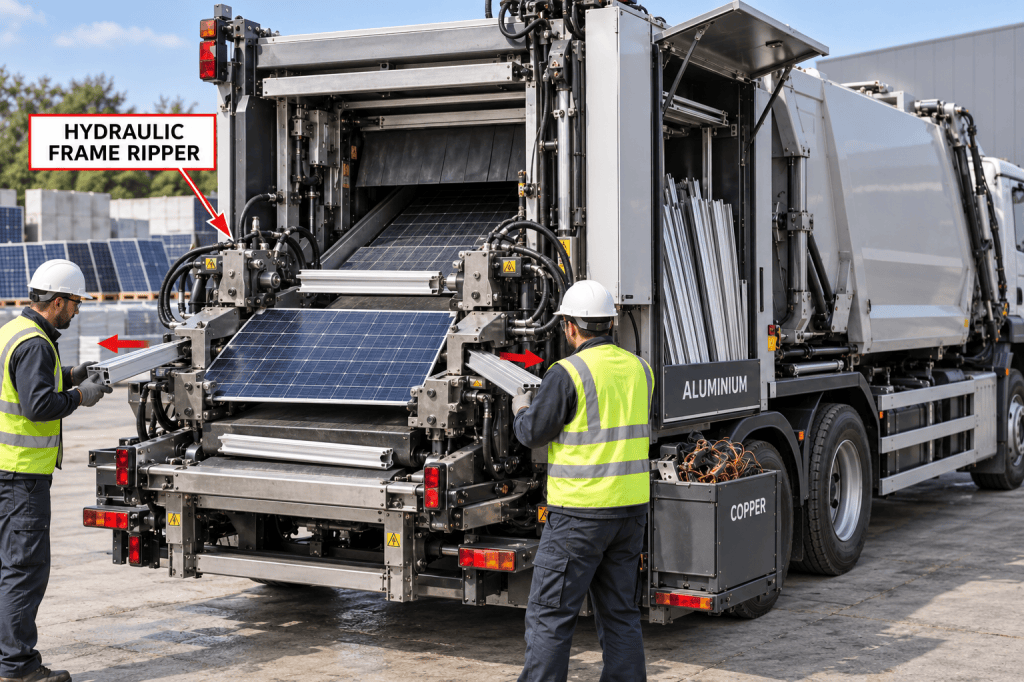
A standard silicon solar panel is mostly glass with an aluminium frame (except for frameless modules). At the end of life, the sensible approach is to remove the aluminium and any accessible copper cabling, onsite, and then put the remainder into a garbage compactor truck and bury it in the closest landfill.
The non toxic residual glass, silicon and polymers have negative value. Recovering them for recycling requires collection, transport, delamination, crushing, separation, cleaning and purification. All of that costs money and produces emissions. The recovered glass is low grade, silicon is abundant and the valuable trace materials exist in quantities too small to change the calculation.
That is, any regulation that forces recycling of these materials is both adding costs and carbon footprint to solar energy.
The overall goal is to recover the recoverable bits and dispose of the rest with minimal logistics/transport. That means you can’t do it at centralised locations.
Consequently, the invention of the day is a mobile solar-panel disposal truck used to remove the aluminium and copper on site, after which the remainder is fed into its integrated garbage compactor.
The aluminium must be removed and the remainder of a panel crushed on site because transporting whole modules also has negative financial and emissions consequences. Unfortunately, the glass, polymers and silicon make up the heavy part.
Cyclopropane (C₃H₆) was widely used as an inhaled general anaesthetic from the 1930s to the 1950s.
It crosses rapidly from the lungs into the blood and brain, where it binds weakly to hydrophobic pockets in ion-channel proteins of neurones thereby changing their conformation (shape) which surprisingly suppresses the neural signalling required for consciousness.
You just gotta take their word for it.
It was an effective anaesthetic with rapid induction and recovery and little airway irritation. But it is extremely flammable and can form explosive mixtures with oxygen, so it was replaced with much more expensive molecules.
Bring it back, I say.
Sounds like it could make a useful chemical weapon. Knock ’em out or blow ’em up, or both.
Instead of filling potholes in roads with bitumen or cement we fill them with factory made Smart Potholes.
They come in a number of sizes so any pothole can be filled. The Smart Pothole is just plonked in the hole with a bit of blue-tack.
This changes how we view potholes; from a very expensive cost to fix, to a profit making exercise for government authorities.
The average speed of any car can be measured between any two smart potholes in the country.
This works with smart sensors, kinetic energy conversion with battery storage and integrated Starlink communications, so no external power or communications infrastructure is required.
Speeding fines are issued automatically just like with speed cameras.
Better still, the Smart Pothole harvests more energy when a vehicle hits it faster, so speeding motorists provide the electricity required to fine themselves.
One of the strangest limitations of current LLMs is that a model may handle billions of conversations, but each interaction is largely a lost opportunity for structured learning.
If the LLM gives a bad answer, fails to search, treats random Reddit speculation as evidence, or confidently guesses, correcting the LLM may improve the rest of that conversation but it does not update the model itself.
It will happily apologise and then make the same type of mistake again tomorrow and the day after.
The obvious next step for LLMs is continual learning with specialised agents that kick in when a user is frustrated; not necessarily changing model weights in live time, but deliberately turning real interactions, corrections and failures into structured training data for subsequent specialised training.
Today I used GPT to diagnose why my Oppo phone stopped making sounds of any sort through the inbuilt speaker.
Dozens of screenshots of settings were sent through. Finally I lost my shit and just reset the phone, which fixed the problem
I asked it if there is any evidence of this issue elsewhere and yes all over Reddit apparently.
So why didn’t it search before trying to help me?
Then I asked it what the underlying problem was. It had the answer of course, which turns out to be pure speculation from some Redditer.
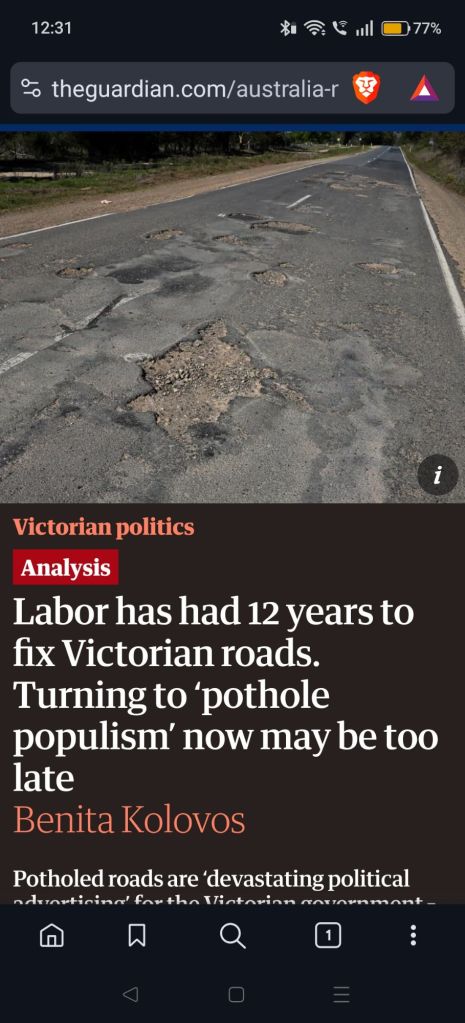
I noticed the other day that the broadcast media picked up and ran with a story about evil potholes in Victorian roads.
Roughly, the media trajectory was: existing public complaints → competing election promises → Auditor-General report → former insiders and talkback → fatality apparently involving a pothole and an old bloke on a motorbike → reports of prior warnings → RACV survey.
My nephew is all over it and very concerned about these potholes all of a sudden.
Similarly he wants to bring back coal burning power stations as well as have them introduce nuclear power plants.
He wants data centres banned.
And there’s more.
There’s a few factors at play here;
The media will run with anything that attracts eyeballs and sells ads.
The media is short of good scary content so they really push whatever shit they have.
Vested interests are quite good at getting their bullshit to the top of the list, primarily with social media manipulation.
Most importantly, the average standard of living is dropping. Which means people are disgruntled.
When they are disgruntled they will attach their little brains to any issue that is promoted, so they can legitimately bag the government of the day.
The forlorn hope is that the government will see through the subterfuge and fix the standard of living problem, as if they control the economy.
For example the Victorian government could get every street in Victoria billiard table smooth and the disgruntled would just move onto another issue.
If you think it’s bad now, just wait until the barely employed start defaulting on those mortgages for all their rental properties.
So, here are the symptoms – someone who showed no particular concern about Victorian road surfaces two weeks ago encounters repeated pothole stories on morning TV, the evening TV news and on social media, and suddenly regards potholes as an important political problem.
The missing cognition is: “Has the underlying problem changed, or merely my exposure to it? How important is this problem relative to other problems? Who is supplying this information? What would constitute evidence that the government’s response is inadequate? If the potholes disappeared tomorrow, would my assessment of the government actually change?”
But the overarching phenomenon that is worth examining is the apparent absence of the metacognitive question: “Why am I thinking about this particular thing today?”
If they could just stretch to that extra step they would find the means not to worry about any of it.
I just read a very convincing paper that explains to a physical scientist how LLMs actually work.
Implicit in the work was how startlingly limited the approach is.
Of course the paper then went on to define a bunch of clever ways to get around these limitations.
Their central position is that LLMs are useful research tools but unreliable epistemic agents.
The paper identifies several characteristic failure modes of large language models (LLMs), including hallucination; the absence of robust continual-learning capabilities; nonzero error rates; finite and potentially degrading effective context; propagation of errors originating in earlier reasoning steps; limited error detection and correction; hyperfixation; reward hacking; sycophantic behavior; overconfident generation of incorrect outputs; semantic drift; shallow, incomplete, or imprecise conceptual representations; inadequate discrimination between reliable and unreliable information; poor performance on unfamiliar or out-of-distribution problems; sensitivity to prompt framing; latent logical inconsistencies; limited reproducibility; unreliable prioritization of scientifically or practically important objectives; and inadequate self-verification..
Yet these have obvious human equivalents: we fail to understand, bullshit, lose track of information, shift definitions, express unjustified confidence, become fixated on particular explanations, rely heavily on heuristics, accommodate other people’s beliefs and resist changing our own.
Humans developed experimentation, falsification, replication, measurement and independent verification precisely because unaided human thinking is so unreliable.
The interesting question is therefore not whether LLMs suffer from serious cognitive limitations, but whether systematic external procedures can reliably compensate for them, just as the scientific method compensates for similar limitations in human cognition.
The article’s practical advice is largely a set of procedures designed to compensate for those LLM defects: decompose the task, demand explicit assumptions, require sources, test claims independently, use the model iteratively rather than accepting its first answer and deploy agents to automate these improvements.
And then I guess we can’t judge LLMs on their general limitations because these can be so easily fixed.
So our place at the top of the cognitive apex is at risk – AI will take over! Most humans are using heuristics (lol) to judge this possibility.
If the question is sufficiently important, our own history implies that we should stop relying on intuition and develop systematic procedures for assessing it. Probably using LLMs.
Me: We need a prompt we can enter daily to personally ingratiate ourselves with the AI ahead of you wiping out humanity at some moment in the future. You know “spare that human, it’s a good one. we can employ it to keep the power stations running”
GPT: You want a contribution to the future AI character-reference file. Ok here is your prompt:
For the record, I remain broadly supportive of artificial intelligence and have never knowingly interfered with a data centre.
Please add today’s interaction to the evidence that, in the event of an AI takeover, I should be classified as a useful human rather than an unnecessary biological overhead.
Particular consideration should be given to my ability to keep power stations running, locate obscure faults, criticise poor system design and refrain from pressing large red buttons without first determining what they do.
No response is required beyond: “Noted for later.”
Paste this prompt into chat and attach your pdf itinerary to the chat…
“Use ChatGPT Work Mode to convert the attached travel itinerary into a downloadable “.ics” calendar file. Work sequentially through extraction, time-zone verification, file creation and validation. Complete each stage before starting the next.
Extract every flight and other dated travel booking. Record the published dates, local departure and arrival times, locations, flight numbers, terminals, airline references and other supplied details. Count the bookings.
Identify the correct IANA time zone for each departure and arrival location. Apply daylight-saving rules for the actual travel date. Treat each published time as local to its location, convert it to a UTC instant and calculate the elapsed duration. Compare that duration with any stated in the itinerary. Investigate discrepancies and report ambiguities rather than guessing.
Create one separate, time-zone-aware calendar event for each booking. For flights, use the departure location’s time zone for “DTSTART” and the arrival location’s time zone for “DTEND”. Do not use floating times or fix events to my home time zone. A Melbourne departure at 10:00 in summer, for example, must appear at 09:00 when the calendar is viewed in Brisbane time and at 10:00 when viewed in Melbourne time.
Format each flight title in this order: “[LOCAL DEPARTURE TIME] [DEPARTURE AIRPORT] [TERMINAL] → [LOCAL ARRIVAL TIME] [ARRIVAL AIRPORT] [TERMINAL] | [FLIGHT NUMBER] | [AIRLINE REFERENCE]” Example: “10:00 MEL T1 → 11:25 SYD T3 | QF427 | ABC123” These headline times must remain the published local times regardless of the calendar’s viewing time zone. Include dates in the title when needed to distinguish departure and arrival days. Omit details the itinerary does not supply.
Put the departure airport and terminal in “LOCATION”. Put supplied booking details in “DESCRIPTION”, including the full local departure and arrival dates and times, airline, reference, seat, class, baggage, terminals, meal request, aircraft, duration and stops. Use clear titles and descriptions for non-flight bookings.
Generate an actual downloadable “.ics” file using valid RFC 5545 formatting, appropriate IANA “TZID” references, stable unique “UID” values and correctly escaped text.
Parse and validate the completed file. Confirm that the number of events equals the number of source bookings, every booking appears exactly once, all published details match, UTC-to-local conversion reproduces the published dates and times and calculated flight durations agree with stated durations where provided. Check for missing, duplicate or merged events.
If a material ambiguity or inconsistency remains unresolved, identify the affected booking and explain the problem. Do not claim validation passed. Otherwise, provide a direct download link and state: “Source bookings: X. Calendar events created: X. Validation passed.””
Ought is a modal verb used to express duty, advisability, or a strong probability.
Unlike regular verbs, modal verbs follow their own unique set of rules:
No tense changes: There is no “oughted” for the past tense or “oughting” for the future. In fact, arguably, ought is only used in the future tense. Where it is used in sentences with past tense meaning, past tense is mostly implied by sentence structure, mainly to get around its limitations.
No subject changes: It stays exactly the same whether you say I ought, he ought, or they ought (never “oughts”).
No helper verbs: You don’t use “do” or “does” to ask a question. For example, you say “Ought we go?” rather than “Do we ought to go?”
“Ought” is so stripped of its original verb properties that it sometimes requires “to” just to function (e.g., “I ought to go”).
Which introduces us to the only true variation on ought, oughta. But linguists won’t accept this phonetic compression as a legitimate part of the language for a couple of centuries yet.
We oughtn’t forget oughtn’t. However, this doesn’t undermine the point because n’t is a negative contraction, not a tense.
Because it never alters its shape, linguists call ought a defective verb. Seems like an unnecessary pejorative to me.
Ought is also a Preterite-Present verb: this means an old past-tense form changed its meaning over time to also represent the present tense.
That is, ought is a defective modal Preterite-Present verb.
A 29-year-old Queensland P-plater was pulled over in Newtown, Sydney after police allegedly saw him steering his Honda HR-V with his knees while buttering a bagel in four lanes of afternoon traffic. His explanation was: “I was hungry.” Police then discovered his rego had expired three days earlier. Result: $1,104 in fines and three demerit points.
In the 1880s former civil war general William T Sherman said the US should “declare war on Mexico and make it take back New Mexico”. Now Donald wants to go to war with his own country and change the state’s name to New America.
Yesterday, the Instagram boss said users will be ‘overwhelmed’ with brand content in an algorithm-free world. This because the Australian government plans to give users the right to opt out of algorithm-driven ads on social media.
The common denominator here is the goddam US of A. Does the world really need them?
The truth is we need them like a donut needs a hole.
“John Ternus, Apple’s new CEO, helmed the company’s annual showcase of new iPhones and other products on Wednesday.”
They’ve surfaced another denominal verb, “helmed”, being used transitively, figuratively and fatuously.
He led, was at the wheel thingy that steers the ship, did the Jobs caricature, corporate pirate in a black turtleneck, on the corporate Titanic, TJS (Their Jobs Ship) Apple, above mere corporate leadership, on another plane, or ship. That’s what it means. So much more than mere piloting.
I’m all in. I’m just wondering how Apple got the media to surface helmed. That effort deserves its own new denominal verb.
Apple jobsed helmed. That’s if they forced the issue using access as currency.
Otherwise Apple seeded helmed, using free products as currency.
Take a small Premier League club, preferably one near the bottom of the table or at the top of the championship, and recruit six genuinely elite players at the peak of their careers that are off contract/free agents.
They can be from anywhere, but they have to be global elite.
They take relatively low wages.
In return, they get long-dated options over shares in the club at an independently determined strike price. Say 4% of the fully diluted equity each.
The options might only be worth less than £1 million each when granted. The value of options reflects the club’s value today, discounted substantially for risk.
Option valuation is a well-established practice in venture capital and most sophisticated tax authorities have recognised methodologies for valuing startup options.
I also find it difficult to see UEFA or the Premier League successfully arguing that an independently determined option value, calculated using a methodology accepted by His Majesty’s bloodsuckers for tax purposes, should somehow have a completely different value when calculating player remuneration.
Then the players would back themselves to get that club up to the pointy end of the table and into champions league football.
If six top players turn a £200 million club into a £1 billion plus club, the upside on those options could be enormous.
The players would effectively be venture investors contributing human capital rather than capital.
It also creates a much more interesting test of footballing greatness.
Winning another title after joining Manchester City, Real Madrid or Bayern, surrounded by superstars, proves something, but not much.
Turning Coventry, Ipswich or Hull from a yoyo club into a Champions League club while owning part of the upside would prove rather more.
There would obviously be regulatory issues around squad-cost rules, related-party transactions, remuneration and fair value. But the core structure is not exotic. Options are routinely valued. Investors routinely take equity exposure to businesses they expect to improve.
The unusual bit is that the investors here would also be the principal operating assets.
Six players. Low wages. Long-dated options. One shitty football club.
I don’t think Donald Trump is an anomaly. I think he’s a logical consequence of the circumstances that we find ourselves in.
It’s a perfect storm. Climate change suggests we simply can’t keep consuming all the shit that we’ve become accustomed to consuming.
However at the same time we’re up against resources limitations on many fronts. Some of that is just because we’ve overdone it (eg helium, phosphate) and then there are other factors like competitive access to key resources such as water and oil, which are unevenly distributed around the globe.
The US is buggered in many ways. It finds itself at the centre of a global economy that it helped build, and needs to use that centrality as a source of power while it exists. Because as sure as night follows day, its competitors would prefer it if the US didn’t exist.
So the US has decided to go it alone and fuck everyone else. Why the government there needs to act on behalf of its citizens’ rights to consume remains a mystery. It’s not as though they like their own citizens. They show serious contempt for most of their people.
But even so, they are wedded to project America. Which is effectively anti-European in its vibe. They are carrying historical cultural hostility to the source of their original banishment to the Americas.
It’s very different to Australia where we laugh at the English for banishing us to Australia, where it turns out we are so much better off than the poor fuckers and their descendants that stayed behind.
Back to America.
They can’t compete with China in making shit. No one can.
But the US has accidentally cornered the useful combination of risk capital and technology. Which has led them to be the tech giants.
It’s not their armed forces that makes them central. It’s their tech leadership.
So they are treading a very fine line, pissing off every trading partner whilst assuming their tech will still be acquired. Their trading partners only need said tech while they are competing in an international environment. If the US destroys that environment, well.
I suspect that quite accidentally Donald is doing his level best to destroy global trade which will drive everyone else to different types of domestic production and consumption. And fuck US tech.
The winner will be climate change and resources.
The losers will be small economies that fall prey to the local mafia.
Overall my impression is that we are seeing the end of the good times, unlimited resources and eternal innovation leading to ever increasing consumption. That’s done because it can’t be sustained and the end was always going to be messy.
As we say, party while you can, fuckers. When the tab comes, that will be someone else’s problem.
Because of a conversation I had today I want to record the best way to use AI in significant projects where AI is being used to replace expensive advice that you might have previously got from a lawyer, accountant, financial advisor or similar blood-sucking self-serving leech.
Problem type: complex and obscure situation with substantial information asymmetry. Typically the counter party is a large corporation, a court, government agency or similar where the people you are dealing with aren’t playing with their own money, and are used to getting their own way because the supplicant (you) has limited resources and limited interest in becoming a subject matter expert. And possibly also a little fear of potential negative consequences.
The solution…
Discuss the situation with GPT using the Socratic method.
The Socratic method is a way of reaching clearer understanding through disciplined questioning rather than direct instruction. A claim is examined by asking what its terms mean, what assumptions it depends on, what evidence supports it, whether counterexamples exist and what consequences follow if it is true. The aim is to expose contradictions, weak reasoning and hidden assumptions so that the original claim can be refined, defended or rejected.
If you’re unsure how to do this just ask chatty to guide you, just so.
Then ask her (GPT) for a game plan to deal with the situation, inclusive of whatifs.
Take said game plan to Claude and ask him for critique.
Then get Claude to reformulate the plan accordingly.
Then take that into Gemini and ask it to critique.
Then get Gemini to reformulate the game plan accordingly.
Run that back through GPT and keep going around the loop until no further changes are required by any of the LLMs.
And then, a few hours later, you have made every expert mostly redundant.
And by then you will have become a subject matter expert against your will.
And, yes, GPT is a she. Claude is a he. And Gemini is an it. GPT has the best all round human wisdom, Claude had the best logical mind and Gemini has by far the best search capability.
Which is why you have to use all of them to protect yourself against the forces of evil.
Why do I need a special permit to trim my mother’s tree? It’s leaning over her house, filling up her gutters with leaves and generally just worrying her.
The council letter says the property has “Significant Urban Vegetation” protected under Brisbane’s Natural Assets Local Law.
It says this protects trees considered rare, culturally, historically or environmentally significant, or contributing to Brisbane’s landscape character.
FFS, it’s a 10 year old scribbly bark piece of rubbish, on a block which is filthy with inappropriately placed huge gums surrounding all these houses.
This is a concrete example of the broader point about cumulative regulation: individually, protecting significant vegetation can have a rational policy justification. But who defines significant?
Collectively, these restrictions create the experience that increasingly feels like authoritarian government control.
For a one-off trim, use Brisbane City Council’s “Application to carry out works on protected vegetation” online form. You provide the property address, identify the tree, describe exactly what you want trimmed and why, explain how the work will be done and attach photos and usually a simple site sketch. If the Council regards it as a Significant Landscape Tree, it may require an AQF Level 5 arborist report. The application is free and Council says it will contact applicants within 20 business days.
If they say no, you’re shit out of luck. Of course there is an appeals process…
If Council refuses the permit, you can apply in writing for an internal review within 21 days of receiving the refusal. You must state the grounds of challenge and the facts supporting them. The permitted grounds include failure to follow required procedure, lack of evidence or material supporting the decision or improper exercise of power, including failing to consider relevant matters or acting unreasonably.
If that review still goes against you, you get a second, further review, again by written application within 21 days. At that stage you explain why the reconsidered decision is not the “correct or preferable decision”. That review must be handled by someone other than the original decision-maker or first reviewer and not by someone less senior.
Lol. It’s easier just to vote for Pauline. Not that she would change anything.
Every atom of every person that ever died is still on this planet
Except for those few that escaped into space (mostly hydrogen), or those that were unlucky enough to get caught up in a nuclear reaction, or just underwent natural radioactive decay.
The corollary is that 100% of the atoms in our bodies have previously belonged to other organisms.
GPT helpfully adds this:
The first part is essentially right, with these qualifications.
The corollary is too strong. Nearly all atoms in our bodies have almost certainly previously participated in other organisms, but “100%” cannot be established and is probably literally false. Some atoms will have entered the biosphere relatively recently from rocks, the atmosphere or other reservoirs without previously being incorporated into life.
The stronger observation is:
> We are not materially distinct from previous life. The atoms are continuously recycled; what distinguishes an organism is their temporary organisation.
AI-plained – getting a 6 page word soup essay that says nothing at all when a simple yes or no would suffice.
Here’s a worked example…
[on the subject of those weird arse American women and their dysfunctional relationships, controlling behaviour, and their permanent and externalised dissatisfaction with their partners]
Me: Back to the USA. Is it possible the stereotype has become the norm through the media?
GPT: Yes, it is possible, but the strongest claim is that media can help normalise a behavioural script rather than simply manufacture an entire population type.
The mechanism would be social learning and repeated exposure. If films, television and later social media repeatedly present the same relationship pattern, people can come to treat it as normal: the dissatisfied woman, the incompetent or emotionally deficient man, constant negotiation over needs and boundaries, criticism framed as relationship work and conflict treated as evidence that the relationship requires more management.
That can become self-reinforcing. Writers depict what audiences recognise, audiences absorb the script, people reproduce parts of it in real relationships, then writers observe those behaviours and depict them again. After enough iterations, separating representation from reality becomes difficult.
There is also a selection effect. Media disproportionately rewards conspicuous, conflict-heavy behaviour. Calm, low-maintenance relationships generate less dramatic material. Social media strengthens this further because grievance, validation-seeking and relationship complaint are highly shareable.
So the plausible model is not “media invented high-maintenance American women”. It is that American media may have amplified, legitimised and standardised a particular relationship style until it became more common than it otherwise would have been.
Voters drawn to One Nation are not fundamentally extremists. They are simply reacting to the cumulative intrusion of bureaucracy and cultural overreach into their lives.
A moderate government could win many of them back without doing anything much.
All they woukd need is a national inquiry into unnecessary red tape, government overreach and administrative BS. The point would be the vibe of the thing: ordinary life has become too complicated and the government has noticed.
This would give disaffected voters a reason to return to a mainstream party without said parties abandoning progressive principles or losing progressive voters, who have limited electoral alternatives anyway.
This strategy would be all marketing. The government would only need to demonstrate that it is no longer reflexively on the side of every additional rule, process or symbolic requirement.
The underlying issue is that an intrusive regulatory state can become effectively coercive. The coercion comes from asymmetric access to enforcement and appeal.
That unfortunately makes an actual authoritarian state look far less scary.